BD APIs – Bangladesh Geo Location API
A fast, free, and open-source REST API providing up-to-date administrative location data of Bangladesh including divisions, districts, upazilas, and unions with bilingual (English & Bengali) support.
General Info
- Client
- Personal Project
- Role
- Full-Stack Developer, API Designer
- Status
- Completed & Actively Maintained
Front-End
Back-End
Tools
Project Overview
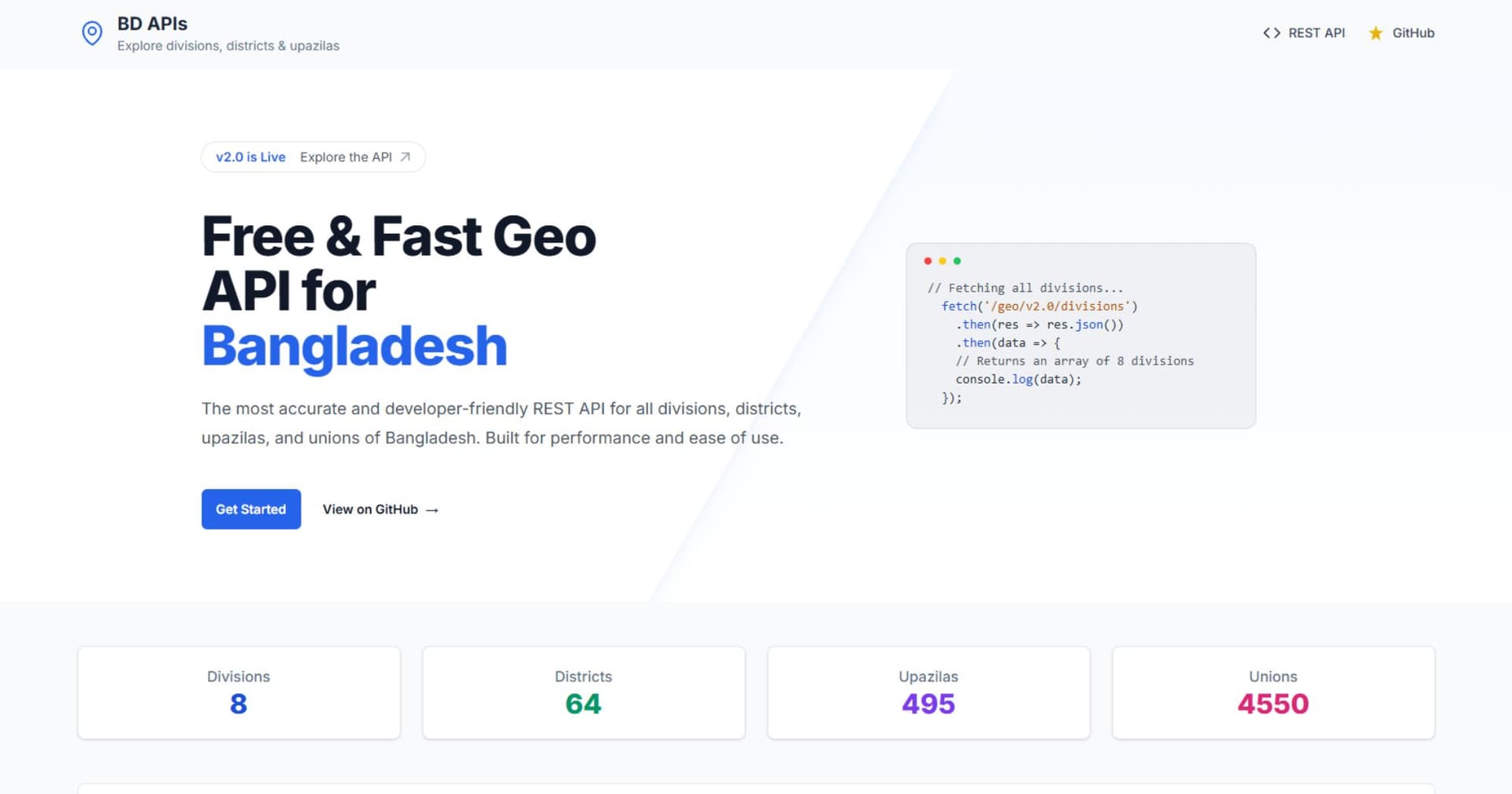
BD APIs is a lightweight, blazing-fast, and completely free RESTful API that provides structured access to Bangladesh's complete administrative geography: 8 Divisions, 64 Districts, 495 Upazilas, and 4550+ Unions. All entities include names in both English and Bengali, making it ideal for bilingual applications.
The project includes an interactive API Explorer UI hosted at https://bdapis.vercel.app, allowing developers to test endpoints instantly without any authentication or API keys.
Built as an open-source project (GitHub: SudipMHX/bd-apis), it serves developers building location-based services, e-commerce delivery systems, government portals, form address pickers, demographic tools, and more.
Core Problem & Solution
Problem
Many existing Bangladesh location APIs were either paid, outdated, incomplete (missing unions or bilingual names), slow, or required complex authentication. Developers in Bangladesh often struggled to find a reliable, free, and maintained source for hierarchical geo-data.
Solution
BD APIs delivers:
- Always-free access with no API key
- Up-to-date data (reflecting 2025 administrative structure)
- Hierarchical filtering (division → district → upazila → union)
- Bilingual support
- Fast responses through caching and optimized data serving
- Clean, predictable JSON structure
- Interactive explorer for quick testing
Key Features
- Complete Bangladesh Geo Hierarchy — Divisions, Districts, Upazilas, Unions
- Bilingual Names — English + বাংলা for every entity
- Smart Filtering — Get districts of a division, upazilas of a district, unions of an upazila
- Global Search —
/search/{query}endpoint with optional type filter - No Authentication — Publicly accessible
- CORS Enabled — Ready for frontend usage
- Caching & Rate Limiting — Built-in performance & abuse protection
- Interactive API Explorer — Test all endpoints directly in browser
- Open Source — MIT licensed, community contributions welcome
Technical Architecture & Deep Dive
The API follows a simple yet performant architecture:
- Data Layer — Static JSON/JS files in
src/database/(fastest for read-heavy workload) + optional MongoDB for future scalability & indexing - API Layer — Express.js routes under
/geo/v2.0 - Performance Layer — node-cache for in-memory caching of frequent queries
- Hosting — Vercel serverless functions (automatic scaling, zero maintenance)
- Frontend — Simple HTML + CSS + vanilla JS explorer UI in
/public
Frontend Architecture
The API Explorer is intentionally lightweight:
- Single-page layout with endpoint cards
- Real-time fetch using
fetch()API - Syntax-highlighted JSON responses
- Copy-to-clipboard functionality
- Responsive design for mobile developers
No heavy frameworks → keeps the landing page load time under 1 second.
In-App Preview
The live site offers a clean, modern interface showing key stats:
- 8 Divisions
- 64 Districts
- 495 Upazilas
- 4550+ Unions
Users can directly click endpoints like /geo/v2.0/divisions or try filtered routes like /geo/v2.0/districts/3 (Dhaka division districts).
Development Process & Challenges
Development Journey
- Collected & cleaned geo-data from reliable sources + government publications
- Structured hierarchical data in JSON format with bilingual fields
- Built Express routes with proper parameter validation
- Added caching layer to handle large union lists efficiently
- Created beautiful API Explorer UI
- Deployed to Vercel with custom domain
- Wrote optimization guide (OPTIMIZATION.md) & maintained documentation
Major Challenges & Solutions
- Large union dataset → Solved with caching + selective population
- Serverless cold starts → Mitigated via Vercel edge caching + warm-up patterns
- Data freshness → Plan to add admin dashboard in future for easy updates
- Abuse prevention → Implemented lightweight rate limiting
The project is actively maintained and welcomes contributions for new features like coordinates, postcodes, or autocomplete search.
Challenges
Ensuring data accuracy and keeping up with occasional administrative changes in Bangladesh (new upazilas/unions). Optimizing response time for large datasets (e.g. 4550+ unions) while hosting on serverless platform. Implementing effective caching and rate limiting without external paid services. Providing bilingual support (Bangla + English) while maintaining clean JSON structure
What I Learned
Deep understanding of hierarchical geographical data modeling. Serverless deployment best practices with Vercel (routing, caching headers, cold starts). Building developer-friendly API documentation and interactive explorer UI. Performance tuning: in-memory caching + static JSON data vs full database queries. Importance of CORS, proper error handling, and input validation in public APIs