BokBok — Real-Time Chat Rooms
A frictionless, ephemeral public chat platform where anyone can create or join real-time chat rooms instantly — no account or sign-up required. Rooms expire automatically and all messages are deleted with them.
General Info
- Client
- Personal Project
- Role
- Full-Stack Developer
- Status
- Completed
Front-End
Back-End
Tools
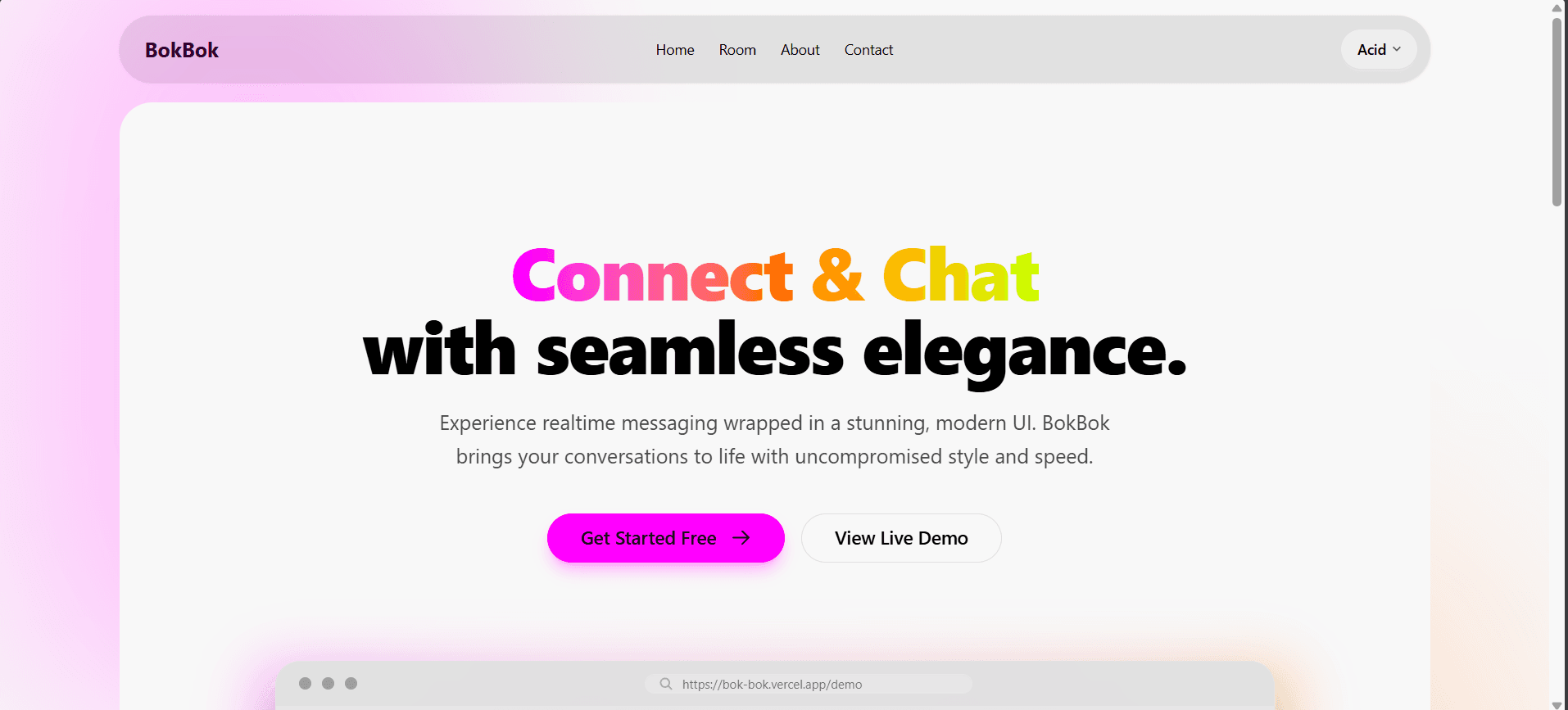
Project Overview
BokBok is a frictionless, ephemeral public chat platform. Create or join real-time chat rooms instantly — no account, no sign-up required. Rooms expire automatically, and all messages are deleted when they do.
The platform is split into two repositories: the frontend (React + Vite + TailwindCSS + DaisyUI) and the backend (Express + MongoDB + Socket.IO). Together they deliver a lightweight, privacy-first chat experience that lives only as long as you need it.
Core Problem & Solution
Most messaging apps require you to create an account, verify an email, or accept tracking cookies just to send a quick message. BokBok removes all of that friction.
The solution is a zero-account, time-boxed chat room system:
- Create a room with a name and an expiry window
- Share the room link with anyone — no invite codes needed
- Chat in real time, then let the room expire and vanish automatically
This makes BokBok ideal for one-off conversations, event co-ordination, or any situation where permanence is a liability.
Key Features
⚡ Real-Time Messaging via Socket.IO
Messages are broadcast instantly across all connected clients using a persistent WebSocket connection. There is no polling and no page refresh required.
🔐 No Account Required
Users pick a nickname when they join a room. The nickname is stored in localStorage under a room-specific key (bokbok_name_<roomId>), so returning to the same room skips the name prompt automatically.
⏳ Expiring Rooms
When creating a room, the host sets an expiry duration. Once the clock runs out, the room and every message inside it are automatically deleted from the database. A live countdown timer in the room header shows how much time remains, changing colour as the deadline approaches.
💬 Typing Indicators & Online Count
A real-time typing indicator shows when other participants are composing a message. A live online user count gives the room a sense of presence.
😀 Emoji Picker
An emoji picker is embedded directly in the message composer, so users can react expressively without leaving the chat interface.
🔗 One-Click Invite Link
Rooms can be shared via a native share sheet on mobile or a one-click copy button on desktop. No extra apps or logins needed for the recipient.
🌍 Multiple Themes
Built on DaisyUI, BokBok ships with Light, Dark, Synthwave, Halloween, and several other themes. The selected theme is persisted in localStorage and applied before React mounts to prevent a flash on reload.
📱 Fully Responsive
Optimised for mobile, tablet, and desktop. The room layout adapts cleanly at every breakpoint.
🔍 SEO Ready
Per-page meta tags, Open Graph, and Twitter Card support are handled via react-helmet-async, so shared links render rich previews on social platforms.
Technical Architecture & Deep Dive
Backend Architecture
The backend is a Node.js server built with:
- Express.js — RESTful API for room and message management
- Mongoose — Schema definition and MongoDB ODM
- Socket.IO — Real-time bidirectional event communication
- TTL Indexes — MongoDB automatically expires room documents after the configured duration
Key API routes:
| Route | Purpose |
|---|---|
GET /api/rooms | List all active rooms |
POST /api/rooms | Create a new room |
GET /api/rooms/:id | Fetch room metadata |
GET /api/rooms/:id/messages | Load message history |
Socket.IO events handle join/leave, message broadcast, typing indicators, and user count updates.
Frontend Architecture
The frontend is a React SPA powered by Vite with:
- React Router — Client-side routing with animated page transitions
- Axios — HTTP requests to
VITE_BACKEND_URL - Socket.IO Client — Connects to
VITE_SOCKET_URLfor live events - react-helmet-async — Per-page SEO meta management
- DaisyUI + Tailwind CSS — Component library and utility-first styling
How Room Auth Works
BokBok uses localStorage instead of server-side accounts:
- On joining a room, the chosen nickname is saved as
bokbok_name_<roomId>. - On revisiting the same room URL, the saved nickname is restored — skipping the name prompt.
- Joined room history is tracked in
bokbok_joined_roomsfor quick rejoin. - Theme preference is persisted under the
themekey and applied before React loads.
Application Routes
| Path | Page |
|---|---|
/ | Home — landing page |
/room | Browse & create rooms |
/room/:id | Live chat interface |
/about | About BokBok |
/contact | Contact page |
/terms | Terms of service |
/privacy | Privacy policy |
* | 404 page |
Development Process & Challenges
Ephemeral Room Cleanup
Ensuring rooms and messages were reliably purged after expiry — without a long-running cron job blocking the event loop — was solved by combining MongoDB TTL indexes on the expiresAt field with a lightweight cleanup utility that runs at server startup to catch any stragglers.
Real-Time Presence Management
Tracking which users are in which rooms across potentially many concurrent Socket.IO connections required maintaining an in-memory map on the server and broadcasting diff events (user joined / user left) efficiently to avoid redundant re-renders on the client.
Zero-Account Identity
Designing a UX that feels seamless without any authentication required rethinking every flow. The localStorage-based identity approach means users are never blocked by a sign-up wall, but it also means the app must gracefully handle cleared storage and re-prompt for a nickname when needed.
Key Learnings
- WebSocket lifecycle management and event-driven architecture with Socket.IO
- Stateless, identity-free user flows using browser
localStorage - MongoDB TTL indexes for automatic document expiry
- Building responsive, multi-theme UIs with DaisyUI
- SEO metadata management in React SPAs using
react-helmet-async
Challenges
Building a truly real-time experience without accounts was the core challenge. Managing room state, user presence, and live typing indicators across multiple concurrent connections required careful Socket.IO event design. Another challenge was implementing ephemeral rooms — ensuring that expired rooms and their messages were reliably purged from MongoDB without impacting active sessions.
What I Learned
This project deepened my understanding of WebSocket lifecycle management with Socket.IO and how to build stateless, identity-free user flows using localStorage. I also gained hands-on experience optimising MongoDB for time-sensitive data with TTL indexes and building a clean, responsive UI with DaisyUI's theme system.